
 Posts


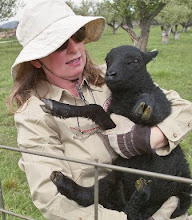
It's fall and time once again for the latest in ovine fashions to be unveiled prior to coming in off pasture and into the corrals for winter hay feeding. Fashionable sheep will be sporting the latest in ovine coats for the winter as designer and manufacturer Oogie M is feverishly working on her new line to debut later this week. All the best ewes will be wearing coats this season to protect their valuable wool from contamination.
This season the watchword is patchwork. Last season's mid range coats are being refreshed with a variety of colorful patches across the body especially prevalent along the sides and around the neckline. Many are made even more eye catching with the addition of contrasting overstitching in black, white and brilliant purple. New this year is the addition of taupe overstitching to highlight some of the more colorful patches. While there are still a few styles with gathers at neck and tail the most stylish coats now sport attractive tail darts instead. Mid range sizes include darts at the girth for a better fit along the forequarters and shorter body hugging leg straps.
Young ewes are forgoing the girth darts in favor of a lean look with only a single pair of tail tucks. Their main colors this year are black and red with white and black stitching visible along all the seams and edges. A few edgy ewes have opted for purple edges making a classic statement against the snow and hay. Leg straps can be in many colors with purple and khaki most common this season in addition to the standard red and black.
We haven't forgotten our plus size ewes with a new line of maternity wear. Styled like their younger sisters' coats these new pieces include ample belly room and discrete darts at the girth to prevent unsightly gaping. The same short leg straps are in evidence but large sizes now sport two pairs of tail tucks. A few of the styles include additional girth darts that can be easily let out as needed.
Fabrics this year are durable, rugged and easy care. Designed to survive harsh Colorado winters they are sunlight and manure resistant. 120 denier nylon Oxford weave is the standard for this Fall collection. Machine washable and built to survive the rigors of fences, this season's new line of sheep coats is sure to be a big hit with all the ewes.
12 September 2007

10 September 2007
Local Food Dinner

One of our local farms Zephyros Farm hosted a farm dinner yesterday evening. About 125 people attended the event celebrating local foods. Each course was prepared by a top local chef and the menu included the sources for all the ingredients. Ryan Hardy from Montangna @ the Little Nell in Aspen did the appetizer course, Eleni Stelter from Eleni's Uptown in Paonia did the salad, Dava Parr from Fresh and Wyld in Paonia did the side vegetables, Mark Fischer of 689 and Phat Thai in Carbondale did the main course and Bob Isaacson of Smith Fork Ranch in Crawford did the desserts. Local wines and distilled spirits were available as well.

We were thrilled to provide all the Black Welsh Mutton for the main course.
Today it's back to the grind of end of summer farm work but last night was a welcome break.
03 September 2007
Labor Day Musings
On a farm every day includes at least some labor. Today was no exception, today we started the sorting process of the ewes. Any that were marked for butcher or for sale got sorted out into the winter corrals for further evaluation. While this may seem to be just physical labor it's actually a skill that is very hard to learn. How do you select whether a bad mother is worse than bad teeth? Does temperament count and for how much? Will a great fleece offset some grey fibers in the fleece? As we processed the entire flock evaluating and sorting sheep I got to thinking about labor and our attitude towards it in the US.
In many cases we denigrate skilled labor that involves physical labor. A skilled fence builder is as much an artist as a manual laborer. At least a good fence builder is. A skilled tailor is far far better than any off the shelf clothing purchased at the nearest discount store but we don't value skilled tailors and refuse to pay for their services so there are fewer and fewer of them. Farmers, who feed us all, rarely if ever get the actual value of the products they produce if you included all the inflation in the costs they pay for materials and other expenses. Right now the going price for lambs on the hoof for slaughter is running about $1.00 per pound. That is for live weight. The parity price, the price the lamb should be bringing if the costs for all the inputs and an allowance for all the inflation that has happened since WW II was included should be around $2.15 per pound. And a live animal is not all meat. There is the head, hooves, hide, guts and other inedible portions. Even once the lamb is reduced to a carcass the cutting and wrapping will reduce the edible portion further by removal of fat, bones and other trim. And unlike every other major livestock species that is slaughtered in the US, sheep are charged a per head slaughter fee. All other animals are charged based on the carcass weight. If you have small sheep it costs the same to have it processed into meat as it does a large sheep. So meat from smaller animals will always cost more to produce.
Small farms like ours cannot compete against multi-national corporations who will import product from the lowest cost vendor. Most of those imports do not count the true cost of the transportation and may ignore wages, working conditions and regulations that producers here are required to comply with. Our labor is only rewarded if we go outside the standard ways to sell our product and sell direct. And because we are small we will never achieve the economy of scale that a larger company can do. So our food and products are always going to be more expensive than the competing products.
So when you next go to the grocery store and complain abut the high cost of domestic food, keep in mind that maintaining a skilled local labor force that can provide high quality food is critical to the long term survival of a culture. Do we really want to be dependent on other countries for our food as well as our oil?
Food for thought this Labor Day.
Subscribe to:
Posts (Atom)